|
|
|
|
|
|
|
|
|
|
|
 |
|
|||||||||
 |
 |
 |
 |
 |
 |
 |
 |
|
||
 |
 |
 |
|
|||||||
 |
|
|||||||||
 |
|
|||||||||
|
Clinical Trials |
|
|
Index of Articles
Updated: January 10, 2026
HuMax-CD20 plus Fludarabine plus Cyclophosphamide
Genmab Announcement.
Phase II Trial of New Chemo-Immunotherapy Combination
 Genmab has recently announced a new chemoimmunotherapy combination clinical trial involving its anti-CD20 monoclonal antibody, HuMax-CD20 (generic name ofatumumab). This is a phase II dose comparison trial. The Genmab protocol combines HuMax-CD20 with fludarabine and cyclophosphamide over a 6 month treatment cycle. The trial is currently being offered at four recruitment centers in the United States. There is reason to hope that HuMax-CD20 will be more effective than Rituxan both as a single agent as well as in chemoimmunotherapy combinations such as this. You can find our discussion of this announcement at: HFC Announcement.
HuMax-CD20: Risks and Rewards
Belt, Suspenders and Cummerbund
Get to Know Ofatumumab
 HuMax-CD20 derives part of its improved efficacy from its capacity to work with a patient's complement system to destroy B-cells. In HuMax-CD20 Risks and Rewards, we examine the potential risks of complement depletion that may accompany intensive treatment with this monoclonal antibody — and suggest a possible precautionary measure for those who are taking part in the Phase III trial of this agent for fludarabine- and Campath-refractory patients.
HuMax-CD20
A Smarter Monoclonal on Trial
What Makes HuMax-CD20 Different from Rituxan?
 In this article we take a closer look at the new agent starring in Genmab's recently announced Phase III clinical trial for fludarabine and Campath refractory CLL patients. This well-designed trial keys in on HuMax-CD20's strengths which we hope will provide significantly better results than singe-agent Rituxan, especially in this difficult patient cohort. To learn more about this pivotal trial and to understand how this important new monoclonal antibody works, read A Smarter Monoclonal on Trial.
Genmab in the News
HuMax-CD20 in Action
Harvey is Back!
 We have an opportunity to see HuMax-CD20 in action when Harvey and Serena pack their bags and travel to England in pursuit of therapy with this new agent. To learn more, read: Genmab in the News.
Sponsored Clinical Trial
Low Hanging Fruit
Improving Routine Immunizations
 Sometimes, when luck is running our way and all the stars are in their correct positions in the heavens, everything comes together just so and we have an opportunity to do ourselves a favor as a community. In our new article, Improving Immunizations, we present a clinical trial to test a method that may boost the efficacy of routine immunizations for CLL patients. We are happy to report that Prof. Terry Hamblin is now working on making this trial a reality.
Chemotherapy
A Direct Comparison of F+C vs F
Is More Necessarily Better?
 The latest issue of Blood carries an article from the German CLL
Study Group comparing single-agent fludarabine against a
combination of fludarabine plus cyclophosphamide. This is a
well-structured, rigorous study and the study group comes to
some surprising conclusions. Read
F+C vs F for our analysis of the
study and comments from an editorial in Blood by Dr. Neil Kay.
The latest issue of Blood carries an article from the German CLL
Study Group comparing single-agent fludarabine against a
combination of fludarabine plus cyclophosphamide. This is a
well-structured, rigorous study and the study group comes to
some surprising conclusions. Read
F+C vs F for our analysis of the
study and comments from an editorial in Blood by Dr. Neil Kay.
Vaccines
A Vaccine Trial for CLL Patients
Finally, It's Our Turn ...
 Genitope Corp. has announced a clinical trial of their MyVax proprietary
vaccine technology for untreated, early stage CLL patients. We
examine this promising technology and the structure of the
Genitope clinical trial in our new article,
A Vaccine Trial for CLL Patients.
Genitope Corp. has announced a clinical trial of their MyVax proprietary
vaccine technology for untreated, early stage CLL patients. We
examine this promising technology and the structure of the
Genitope clinical trial in our new article,
A Vaccine Trial for CLL Patients.
FCR 'Lite'
The Search for Efficacy with Lower Toxicity
New Clinical Trial Seeks the Goldilocks Solution
 A new chemoimmunotherapy combination employing a higher dosage of Rituxan with
reduced dosages of fludarabine and cyclophosphamide, is
being tested in a clinical trial at the University of Pittsburgh
Cancer Institute. The investigators would like to achieve high
response rates with lower toxicity compared to FCR "Classic"
pioneered at M. D. Anderson Cancer Center. We review the
protocol and comment on the clinical trial design in our article
on FCR Lite. We also
interviewed Dr. Kenneth Foon, the principal investigator for
this clinical trial at UPMC.
A new chemoimmunotherapy combination employing a higher dosage of Rituxan with
reduced dosages of fludarabine and cyclophosphamide, is
being tested in a clinical trial at the University of Pittsburgh
Cancer Institute. The investigators would like to achieve high
response rates with lower toxicity compared to FCR "Classic"
pioneered at M. D. Anderson Cancer Center. We review the
protocol and comment on the clinical trial design in our article
on FCR Lite. We also
interviewed Dr. Kenneth Foon, the principal investigator for
this clinical trial at UPMC.
HuMax Clinical Trial
Early Results from GenMab's Anti-CD20 Monoclonal Antibody
The Half-Full Glass
 We have high hopes for the new generation of monoclonal antibodies
that are under development and have discussed new trials under
way to test these agents in the clinic. Early results form one
such trial, involving GenMab's HuMax, were highlighted at the
2005 ASH conference in Atlanta. We offer our analysis of the
published results in Results from
GenMab's HuMax Clinical Trial.
We have high hopes for the new generation of monoclonal antibodies
that are under development and have discussed new trials under
way to test these agents in the clinic. Early results form one
such trial, involving GenMab's HuMax, were highlighted at the
2005 ASH conference in Atlanta. We offer our analysis of the
published results in Results from
GenMab's HuMax Clinical Trial.
Targeting Bcl-2
Anti-death Protein Protects Cancer Cells
We Review Clinical Trials of Three Different Drugs
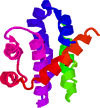 Clinical trials are currently under way testing three different drugs to
suppress or attack a family of proteins that confers longevity
to CLL cells. We review the science behind this approach — and
give you our take on the drugs and the clinical trials — in
Targeting Bcl-2.
Clinical trials are currently under way testing three different drugs to
suppress or attack a family of proteins that confers longevity
to CLL cells. We review the science behind this approach — and
give you our take on the drugs and the clinical trials — in
Targeting Bcl-2.
Clinical Trials
A Patient Sponsored Clinical Trial
Project Alpha Kickoff
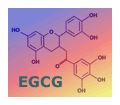 It has taken longer than we thought it would, but we are
pleased to announce Project Alpha is finally ready to start
recruiting patients. It represents a first of its kind
collaboration between patients and the research community.
Your hard earned money went into making this "EGCG trial" a
reality. You can read all the details of this newly
announced clinical trial at Mayo Clinic, Rochester MN, in
our new article,
Project Alpha Kickoff.
It has taken longer than we thought it would, but we are
pleased to announce Project Alpha is finally ready to start
recruiting patients. It represents a first of its kind
collaboration between patients and the research community.
Your hard earned money went into making this "EGCG trial" a
reality. You can read all the details of this newly
announced clinical trial at Mayo Clinic, Rochester MN, in
our new article,
Project Alpha Kickoff.
Clinical Trials
The Importance of Screening
FMC plus R: Brit. Version
 Drawing from the information sheet provided to patients in the UK FCM/FCM-R CLL trial,
we make some comparisons with the previously discussed M. D. Anderson clinical trial
(Mitoxantrone to Turbocharge FCR Combo?).
The issue of pre-screening participants for cardiac conditions is being addressed
differently in the U. K. trial as you will see in
"FMC plus R - Brit. Version".
Drawing from the information sheet provided to patients in the UK FCM/FCM-R CLL trial,
we make some comparisons with the previously discussed M. D. Anderson clinical trial
(Mitoxantrone to Turbocharge FCR Combo?).
The issue of pre-screening participants for cardiac conditions is being addressed
differently in the U. K. trial as you will see in
"FMC plus R - Brit. Version".
Clinical Trials
MD Anderson Responds
More on Mitoxantrone plus FCR
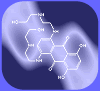 We are pleased to report that Dr. Stefan Faderl, the principal investigator
at M. D. Anderson Cancer Center for the FCR+M and Neulasta clinical trial,
has responded to our letter and the review of the clinical trial we published
yesterday (see story introduction below:
Mitoxantrone to Turbocharge FCR Combo?).
We offer our recommendations regarding this trial and a commentary by
Dr. Terry Hamblin in
More on Mitoxantrone plus FCR.
We are pleased to report that Dr. Stefan Faderl, the principal investigator
at M. D. Anderson Cancer Center for the FCR+M and Neulasta clinical trial,
has responded to our letter and the review of the clinical trial we published
yesterday (see story introduction below:
Mitoxantrone to Turbocharge FCR Combo?).
We offer our recommendations regarding this trial and a commentary by
Dr. Terry Hamblin in
More on Mitoxantrone plus FCR.
Clinical Trials
Mitoxantrone Is Added to FRC Regime
Kick It Up Another Notch?
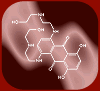 We review a new clinical trial currently recruiting patients at
M. D. Anderson Cancer Center. Our article, "Mitoxantrone to Turbocharge FCR Combo?" is required reading for those considering
enlisting in the Anderson FCR+M clinical trial - or for those simply interested
in evaluating the risks and benefits of enrolling in any CLL clinical trial.
We review a new clinical trial currently recruiting patients at
M. D. Anderson Cancer Center. Our article, "Mitoxantrone to Turbocharge FCR Combo?" is required reading for those considering
enlisting in the Anderson FCR+M clinical trial - or for those simply interested
in evaluating the risks and benefits of enrolling in any CLL clinical trial.
Chemotherapy Trials
Hsp 90 and Its Inhibition by 17-AAG
An Important New Trial Has Been Announced
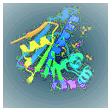 17-AAG may turn out to be an important therapeutic drug for CLL.
It has an interesting mechanism of action and should in theory work
well in poor prognostic cases. An important new phase I trial of
17-AAG has been announced and is recruiting patients at OSU, soon to
be followed by Dana Farber. You can read all about it in our article
17-AAG - An Important New
Trial Has Been Announced.
17-AAG may turn out to be an important therapeutic drug for CLL.
It has an interesting mechanism of action and should in theory work
well in poor prognostic cases. An important new phase I trial of
17-AAG has been announced and is recruiting patients at OSU, soon to
be followed by Dana Farber. You can read all about it in our article
17-AAG - An Important New
Trial Has Been Announced.
New Clinical Trial at Mayo
Protocol for Previously Untreated Patients
Short Duration Campath plus Rituxan
 A new protocol combining short duration subcutaneous Campath
with standard dose Rituxan has been launched at the Mayo Clinic,
Rochester, MN. It targets previously untreated Rai Stage 0-II
patients. Read our review of the protocol and the relevant detail
and background in
Clinical Trial to Test Rituxan plus Short Duration Campath.
A new protocol combining short duration subcutaneous Campath
with standard dose Rituxan has been launched at the Mayo Clinic,
Rochester, MN. It targets previously untreated Rai Stage 0-II
patients. Read our review of the protocol and the relevant detail
and background in
Clinical Trial to Test Rituxan plus Short Duration Campath.
 Search this site for: |
———
Disclaimer: The content of this website is intended for information only and is NOT meant to be medical advice. Please be sure to consult and follow the advice of your doctors on all medical matters.
Copyright Notice:
Copyright © 2026-2006 CLL Topics, Inc. All Rights Reserved.
All materials contained on this site are protected by United States copyright law and may not be reproduced, distributed, transmitted, displayed, published or broadcast without the prior written permission of CLL Topics, Inc. You may not alter or remove any trademark, copyright or other notice from copies of the content.
However, you may download and print material from CLLTopics.org exclusively for your personal, noncommercial use.
———
 |

Clinical Trials
|
|
|
 |
 |
|